Growth Factor Concentrate (GFC) for Hair: The Complete Guide
Hair loss treatment has evolved considerably over the last decade. Where patients once had limited options — minoxidil, finasteride, and surgery — the field of regenerative medicine has introduced a new class of biological treatments that use the body’s own healing mechanisms to address follicle dysfunction at a cellular level.
Growth Factor Concentrate (GFC) is among the most significant of these advances. It is not simply an evolution of PRP — it is a fundamentally different preparation that targets the same biological problem with greater precision and, according to emerging clinical evidence, more consistent results.
This guide covers everything: the science behind GFC, exactly how it differs from PRP, who it works for, what the treatment process involves, realistic session timelines, what results actually look like, and the key questions to ask before starting treatment.
What Is Growth Factor Concentrate (GFC)?
To understand GFC, it helps to first understand what PRP — Platelet-Rich Plasma — is and does.
In PRP treatment, a blood sample is centrifuged to concentrate the platelet layer, which is then injected into the scalp. Platelets contain alpha granules — cellular structures packed with growth factors that signal tissue repair, cell proliferation, and angiogenesis. When PRP is injected, these growth factors are released at the injection site, stimulating dormant hair follicles and improving the scalp micro-environment.
GFC takes this principle further. Rather than injecting the entire platelet-rich plasma — which includes platelets, white blood cells, red blood cells, and inflammatory mediators — the GFC preparation process specifically activates the platelets and extracts only the released growth factors. The result is a cell-free, purified growth factor solution that contains a significantly higher concentration of active proteins than standard PRP, minimal to no red or white blood cells, and virtually no inflammatory mediators — the components of PRP that can cause post-injection discomfort and partially counteract the regenerative effect.
The injectable solution delivered in GFC is, in biological terms, a more refined and targeted stimulus for hair follicle regeneration compared to whole platelet-rich plasma.
The Key Growth Factors in GFC and What They Do
The therapeutic effect of GFC comes from the concentrated action of several specific growth factors, each playing a defined role in follicle biology. Understanding what these are helps explain why GFC produces the results it does.
PDGF — Platelet-Derived Growth Factor stimulates dermal papilla cells and promotes follicle cycling into the active growth phase. It is one of the primary drivers of follicle reactivation in GFC therapy.
VEGF — Vascular Endothelial Growth Factor promotes the formation of new blood vessels around hair follicles, directly improving the delivery of nutrients and oxygen that follicles need to sustain active growth. Poor scalp circulation is a contributing factor in many hair loss cases, and VEGF addresses this at a biological level.
EGF — Epidermal Growth Factor triggers the proliferation of keratinocytes — the cells that produce the hair shaft — and supports the structural development of the hair fibre itself.
IGF-1 — Insulin-Like Growth Factor 1 is one of the most important growth factors for hair specifically. It prolongs the anagen phase — the active growth period of the hair cycle — and delays the follicle’s entry into the regression phase. Longer anagen cycles mean longer, thicker, denser hair.
TGF-β — Transforming Growth Factor Beta regulates the overall hair growth cycle and plays a role in moderating the inflammatory response in the scalp, which is particularly relevant in cases where scalp inflammation is contributing to follicle dysfunction.
FGF — Fibroblast Growth Factor supports the survival of dermal papilla cells — the master regulators of follicle behaviour — and helps maintain the architectural integrity of the follicle structure.
HGF — Hepatocyte Growth Factor promotes hair follicle development and is involved in inducing follicles into the anagen phase from a resting state.
In standard PRP, all of these growth factors are present but in moderate concentration and mixed with cellular components that may dilute or partially counteract their effect. In GFC, they are delivered in a purified, concentrated form directly at the follicle level — which is the fundamental reason why GFC typically requires fewer sessions than PRP to achieve comparable or superior results.
GFC vs PRP: What Is Actually Different?
This is the question most patients ask, and it deserves a thorough answer rather than a marketing-led oversimplification.
The most fundamental difference is what is being injected. In PRP, the whole platelet-rich plasma layer — containing platelets, white blood cells, residual red blood cells, and plasma — is injected directly into the scalp. In GFC, the platelets are first activated within a closed system, causing them to release all their stored growth factors. Those released growth factors are then extracted as a purified solution, leaving the cellular debris behind. What is injected in GFC is therefore not plasma — it is the concentrated biological signal itself.
In terms of growth factor concentration, standard PRP typically delivers a concentration of around 3 to 5 times that found in whole blood. GFC, depending on the protocol and preparation kit used, delivers concentrations estimated at 8 to 10 times baseline — sometimes higher. This difference in potency is one of the primary reasons GFC patients often see results more quickly and with fewer sessions.
The absence of inflammatory components in GFC is also clinically significant. White blood cells in PRP release cytokines — some of which are pro-inflammatory and can counteract the regenerative effect of the growth factors. By removing these cellular components, GFC delivers a cleaner, more targeted biological stimulus with noticeably less post-treatment scalp discomfort.
From a practical standpoint, GFC takes slightly longer to prepare — approximately 25 to 35 minutes compared to 15 to 20 minutes for standard PRP — because of the additional activation and extraction steps. It is also typically more expensive than PRP. However, patients generally require fewer initial sessions to achieve their target outcome, which partially offsets the higher per-session cost.
PRP remains a well-evidenced, cost-effective treatment for early hair loss and is the right starting point for many patients. GFC is not a replacement for PRP in all scenarios — it is the more appropriate choice for patients with moderate to significant hair loss, those seeking faster visible results, or those who completed a course of PRP without adequate response.
A 2021 randomised controlled trial published in the International Journal of Trichology comparing PRP and GFC in androgenetic alopecia patients found that GFC produced statistically superior improvements in hair density and hair shaft thickness compared to PRP at the 6-month follow-up mark. Patients in the GFC group also reported less post-injection discomfort — consistent with the lower inflammatory profile of the preparation.
Who Is GFC Hair Treatment Right For?
GFC produces its most consistent results in specific patient profiles, and being honest about those profiles prevents wasted time and money for patients who are better served by a different approach.
The treatment is ideally suited for patients with androgenetic alopecia — both male and female pattern hair loss — particularly in the moderate to moderately advanced stages where significant follicle miniaturisation is underway but the follicles are still present and viable. It also works well for patients with diffuse hair thinning across the scalp without complete bald patches, and for those experiencing post-partum hair loss, where follicles have entered a prolonged resting phase following the hormonal shift of delivery.
Patients who experience stress-induced or reactive hair loss — where the trigger has been addressed but follicles need biological stimulation to recover — typically respond well to GFC. It is also widely used before and after FUE hair transplantation to improve scalp vascularity before surgery and accelerate graft survival and regrowth afterward.
One of the most clinically important use cases for GFC is in patients who have completed a standard PRP course without satisfactory results. Because GFC delivers a higher growth factor concentration with fewer inflammatory components, it often produces meaningful response in follicles that did not respond adequately to PRP.
GFC is not appropriate for everyone. It will not produce results in areas of complete baldness where follicles have already been lost — there is no biological material left for the growth factors to stimulate. Similarly, it is not suitable for scarring alopecia, where the follicles have been permanently destroyed by inflammatory or fibrotic processes. Patients with active scalp infections, severe seborrhoeic dermatitis, or psoriasis need to have their scalp stabilised before starting any injection-based treatment. Those on anticoagulant medications also need a medical review before proceeding, as blood thinners affect platelet function and may reduce GFC efficacy.
The GFC Hair Treatment Process: Step by Step
The GFC preparation involves an additional stage compared to PRP, which is why appointment times are slightly longer. Here is what a typical session involves.
The session begins with a scalp assessment. Before any GFC is administered, a qualified dermatologist evaluates the pattern and severity of hair loss, reviews scalp health, and confirms that GFC is the appropriate treatment for the patient’s specific profile. At Vesta Skin by Dr. Uma, this is done during a free initial consultation, and a personalised hair regrowth treatment plan is developed from that assessment before any injections begin.
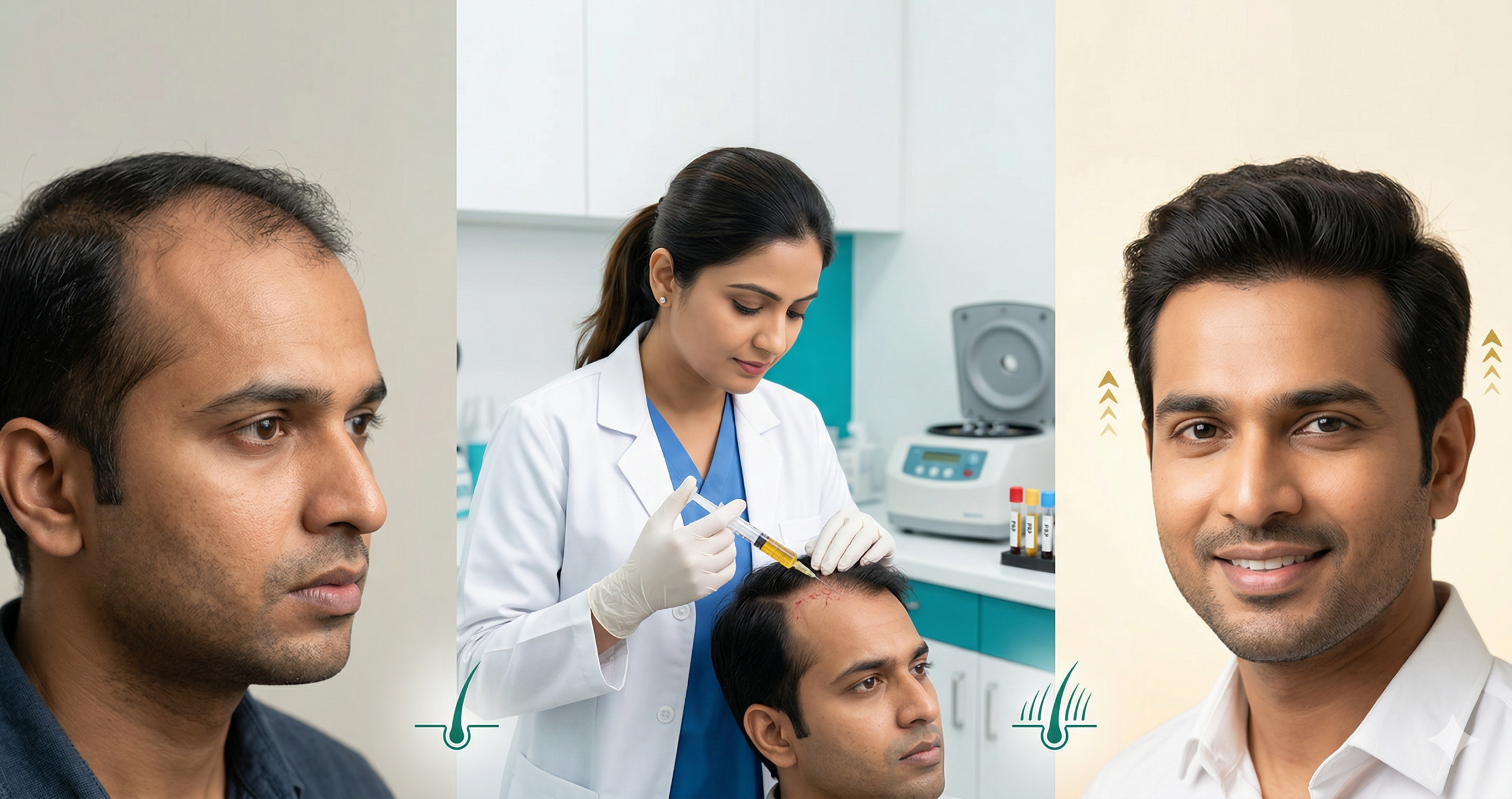
Once treatment is confirmed, approximately 16 to 20 ml of blood is drawn from a vein in the arm — the same volume as a routine blood test. The sample is placed into a specialised, closed GFC preparation kit and centrifuged to concentrate the platelet layer. A platelet activator — typically calcium gluconate — is then introduced, triggering the platelets to degranulate and release all their stored growth factors into the surrounding plasma. The activated growth factor solution is extracted through a filtration process, leaving the cellular components behind. The resulting fluid is a clear to pale-yellow liquid, distinctly different in appearance from the straw-coloured PRP seen in standard preparations.
Before injection, a topical anaesthetic cream is applied to the scalp and left for 20 to 30 minutes. The GFC solution is then injected at intervals of approximately 1 to 1.5 centimetres across the thinning areas, targeting the follicle bulb at a depth of 4 to 6 millimetres. Most patients report notably less discomfort during GFC injection compared to PRP — a direct consequence of the lower inflammatory content. The injection phase takes 20 to 30 minutes, and the total appointment from blood draw to completion runs approximately 60 to 75 minutes.
After the session, patients return to their normal activities immediately. The scalp may feel mildly tender for a few hours, and minor redness at injection points typically resolves within 6 to 12 hours. Hair washing is advised from the following morning, with avoidance of heat styling, chemical treatments, and intense physical exercise for 48 hours.
How Many GFC Sessions Do You Need?
Session requirements vary based on the type, stage, and cause of hair loss, but general clinical guidance gives a realistic framework for expectation-setting.
For patients with early diffuse thinning, 2 to 3 sessions spaced every 4 weeks is typically sufficient for an initial course, followed by maintenance sessions every 5 to 6 months. Patients with moderate androgenetic alopecia generally need 3 to 4 sessions spaced every 3 to 4 weeks, with maintenance every 3 to 4 months. Those with more significant thinning or advanced androgenetic alopecia may require 4 to 6 sessions spaced every 3 weeks, with more frequent maintenance at 3-monthly intervals. Patients switching from PRP after an inadequate response typically need 3 to 4 sessions spaced every 3 weeks. For those using GFC to support an FUE hair transplant, 1 to 2 sessions timed around the surgery date and maintenance every 6 months is the standard approach.
What to Expect Month by Month
The most important thing to understand about GFC results is that they follow biological timelines — not treatment timelines. Hair follicles go through growth cycles measured in months, not weeks, and progress cannot be rushed.
During the first month, the most reliable early sign that GFC is working is a reduction in daily hair fall. Patients who have been losing significant amounts of hair every day typically notice the shedding begins to slow within 3 to 6 weeks of the first session. This reduction in shedding is the follicles responding to the growth factor stimulus before visible regrowth appears.
By the second month, fine vellus hairs — light-coloured and soft — begin to emerge in areas of thinning. These are previously dormant follicles re-entering the anagen phase. They will gradually thicken over the following months as they transition from vellus to terminal hairs.
From months 3 to 4, new terminal hairs become visible and measurable. Overall hair density in treated areas shows quantifiable improvement, and patients with mild to moderate loss often see their most encouraging changes in this window.
By months 5 to 6, the full outcome of the initial GFC course becomes visible. Hair density, shaft thickness, and overall scalp coverage reach their peak improvement from the initial treatment series. This is the point at which before-and-after photographs are most revealing.
Beyond month 6, the treatment enters the maintenance phase. Without continued maintenance sessions, results begin to plateau and may gradually decline as the growth factor stimulus diminishes and the underlying androgenetic process continues. Scheduled maintenance sessions sustain the improvement and, over multiple treatment cycles, produce cumulative long-term density gains.
Why Maintenance Sessions Matter More Than Most Patients Realise
One of the most common mistakes in GFC treatment is completing the initial course and then stopping entirely. Hair loss — particularly androgenetic alopecia — is a progressive, chronic condition. The underlying hormonal and genetic factors driving follicle miniaturisation do not stop because treatment has been completed.
GFC suppresses the rate of miniaturisation and reactivates dormant follicles for a finite period. Without periodic maintenance — typically every 3 to 6 months depending on loss severity — follicles that responded to treatment will gradually begin to miniaturise again as the growth factor effect diminishes.
Think of GFC maintenance the same way you would think of maintenance for any managed chronic condition: when continued consistently, the treatment keeps the problem under meaningful control. When stopped, the underlying condition re-establishes itself. Patients who commit to a structured initial course followed by regular maintenance consistently report the best long-term outcomes — in terms of both hair density and slowing overall progression.
GFC as Part of a Comprehensive Hair Loss Strategy
For most patients, GFC works best not in isolation but as part of a broader hair health protocol. Dermatologists commonly combine it with several complementary approaches.
Topical minoxidil is one of the most common adjuncts. Minoxidil extends the anagen phase and increases follicle size through a different biological pathway than GFC — meaning the two treatments complement each other rather than overlap. Used together, they address hair loss from two independent mechanisms simultaneously, typically producing better outcomes than either alone.
For male patients with androgenetic alopecia, oral medications such as finasteride or dutasteride address the root hormonal cause of follicle miniaturisation — the conversion of testosterone to DHT in the scalp. GFC manages the follicle-level consequences of DHT damage; DHT blockers reduce the damage at its source. The combination consistently outperforms either treatment in isolation for this patient group.
Nutritional support is frequently underestimated in its importance. Iron deficiency, vitamin D deficiency, zinc deficiency, and inadequate protein intake — all common across India — significantly limit how well follicles respond to any biological treatment. Identifying and correcting these deficiencies before or alongside GFC treatment substantially improves response rates.
Scalp hygiene is equally important. A clean scalp free from seborrhoeic dermatitis, dandruff, and excess sebum responds more favourably to GFC injections. Dandruff treatment alongside GFC is frequently recommended for patients where chronic scalp inflammation is contributing to follicle stress.
For patients with areas of complete baldness where follicles are entirely absent, GFC alone cannot produce results in those areas — but FUE hair transplant can. GFC is then used as a pre and post-surgical adjunct to improve the scalp environment and accelerate graft recovery. At Vesta Skin, Dr. Uma designs comprehensive hair loss strategies that determine whether GFC, PRP, FUE, or a combination approach is most appropriate for each patient’s specific profile.
Common Questions and Honest Answers
Is GFC painful?
Most patients find GFC more comfortable than standard PRP because of its lower inflammatory content. Topical anaesthetic is applied before injection, and the procedure is generally well-tolerated. Some scalp tenderness for a few hours after treatment is normal and expected.
Is GFC safe?
Yes. Because GFC uses your own blood, allergic reactions are essentially impossible. The preparation is done in a closed, sterile system that minimises contamination risk. Side effects are limited to temporary, localised scalp tenderness and minor redness at injection sites — both of which resolve within hours.
Can women get GFC for hair loss?
Absolutely. Female pattern hair loss — which presents as diffuse thinning across the crown and widening of the parting — responds well to GFC. It is one of the most effective non-surgical options for women with androgenetic alopecia who cannot or prefer not to take hormonal medications.
How does GFC compare to FUE hair transplant?
They address fundamentally different problems and are not competing alternatives. GFC stimulates existing follicles and is appropriate for patients who still have viable hair follicles in thinning areas. FUE transplants donor follicles into areas where follicles are absent or too depleted to function. The two treatments are often used together — GFC before surgery to optimise scalp health, and after surgery to accelerate graft survival.
When is GFC not enough on its own?
When hair loss has progressed to the point where significant bald areas have formed and follicles are no longer present to stimulate, GFC cannot produce results in those areas. A consultation with a qualified dermatologist determines whether GFC alone is sufficient or whether a combined approach with FUE is more appropriate.
How long do GFC results last?
The initial course produces results most visible at 4 to 6 months. Without maintenance, results typically begin to diminish within 6 to 12 months as the underlying androgenetic process continues. With scheduled maintenance every 3 to 6 months, improvements can be sustained and progressively built upon over several years.
What is the cost of GFC hair treatment in Chennai?
Pricing varies depending on the clinic, preparation protocol, and number of sessions required. Contact Vesta Skin for transparent, personalised pricing following your initial scalp assessment.
What to Look for in a GFC Hair Treatment Clinic
The quality of GFC treatment depends critically on the preparation protocol used and the clinical skill of the administering dermatologist. When evaluating clinics, these are the questions worth asking.
First, ask what GFC kit system the clinic uses. Closed, validated GFC preparation kits from established manufacturers produce more consistent growth factor concentrations and reduce contamination risk compared to open or improvised preparation systems. The kit used directly affects the potency and safety of what is being injected.
Second, ask who performs the scalp assessment and injections. GFC scalp injections should be performed by — or under the direct supervision of — a qualified dermatologist. Accurately assessing hair loss type, cause, and treatment appropriateness requires medical expertise that goes beyond injection technique alone.
Third, ask whether the clinic assesses the underlying cause of your hair loss before starting treatment. Any clinic that proceeds directly to injections without understanding why a patient is losing hair is not providing complete care. Treating the wrong type of hair loss with GFC will not produce meaningful results.
Finally, ask about the post-treatment plan. GFC is not a standalone procedure — it works best when integrated into a broader treatment plan that includes maintenance scheduling, concurrent topicals where appropriate, and nutritional guidance. A clinic that offers only injections without addressing the broader picture is providing incomplete care.
For patients in Chennai seeking GFC under expert dermatological supervision, Vesta Skin by Dr. Uma offers a free initial consultation that includes a thorough scalp and hair loss assessment before any treatment recommendation is made. Book your consultation here.
Final Thoughts
Growth Factor Concentrate represents a meaningful step forward in non-surgical hair loss treatment. Its higher growth factor concentration, reduced inflammatory profile, and generally superior outcomes compared to standard PRP in moderate to significant hair loss make it an important option for patients who have not responded adequately to conventional treatments — or who are looking for the most advanced available approach to hair follicle regeneration.
But like any hair loss treatment, it is not universally effective, and it is not a substitute for an accurate diagnosis. The most important investment any patient can make before committing to GFC — or any hair treatment — is a thorough initial consultation with a qualified dermatologist who can assess the type, cause, and stage of their hair loss and recommend the most appropriate path forward.
If you are based in or near T Nagar, Chennai, and want an honest, detailed assessment of whether GFC is the right solution for your hair loss, Vesta Skin by Dr. Uma offers free consultations where Dr. Uma evaluates your scalp thoroughly before making any treatment recommendation.
📞 +91 7709393369 / 9342548815
📍 Third Floor, Villa, 12/26, Coats Road, T Nagar, Chennai — 600017