Laser Toning for Pigmentation: How Many Sessions Do You Actually Need?
The number of laser toning sessions needed for pigmentation depends on the type of pigmentation, its depth, your skin tone, and how well you protect your skin between sessions. Most patients need between 4 and 8 sessions spaced 2 to 4 weeks apart. Melasma typically requires more sessions than sun spots or post-acne marks — and maintenance sessions are almost always necessary to prevent recurrence.
“How many sessions will it take?” is almost always the first question people ask when considering laser toning for pigmentation. It is also the question that most clinics answer vaguely — often because the honest answer is more nuanced than a simple number.
The truth is that laser toning is not a one-size-fits-all treatment, and the number of sessions you need depends on several variables that are specific to your skin. Giving every patient the same answer — “6 sessions” — without assessing those variables is a disservice to the patient and a red flag worth noticing.
This guide breaks down what laser toning actually does to pigmented skin, why the session count varies so significantly across different conditions, what realistic results look like at each stage, and what factors determine whether your pigmentation responds quickly or requires a longer treatment course.
What Is Laser Toning and How Does It Target Pigmentation?
Laser toning — also called laser skin toning or Q-switched Nd:YAG laser treatment — is a non-ablative laser procedure that targets excess melanin in the skin without damaging the surrounding tissue. It works by delivering rapid pulses of laser energy at specific wavelengths that are selectively absorbed by melanin clusters — the pigment deposits responsible for dark spots, uneven skin tone, and discolouration.
When the laser energy is absorbed by melanin, it causes the pigment granules to fragment into smaller particles. These fragments are then gradually cleared by the body’s immune system through the lymphatic drainage process — a biological mechanism that takes time, which is why results develop progressively across multiple sessions rather than appearing all at once after the first treatment.
Unlike ablative laser treatments that remove the outer skin layer, laser toning works at a sub-surface level. The epidermis remains intact throughout the procedure, which is why there is no visible peeling, no open skin, and no significant downtime. This also makes it one of the more suitable laser options for darker South Asian skin tones — where aggressive resurfacing lasers carry a higher risk of triggering post-inflammatory hyperpigmentation (PIH).
In addition to its pigment-clearing effect, laser toning stimulates collagen production in the dermis, which contributes to improved skin texture, reduced pore size, and a progressive brightening of the overall complexion over the course of a treatment plan.
At Vesta Skin by Dr. Uma in T Nagar, Chennai, the clinic uses the Iris Bluetoning system — a QS Nd:YAG laser with a unique bluetoning mode that delivers energy in two calibrated bouts for more precise pigmentation targeting with additional collagen induction. This is one of several advanced laser systems available for pigmentation treatment in Chennai.
The 4 Main Types of Pigmentation — and Why Each Responds Differently
Before estimating how many sessions you need, your dermatologist needs to accurately identify the type of pigmentation you have. These are not interchangeable — their depth, cause, and response to laser toning vary considerably.
1. Melasma
Melasma is a chronic, hormonally-driven pigmentation condition that produces symmetrical dark patches — typically across the cheeks, forehead, and upper lip. It is one of the most common pigmentation concerns in India, particularly among women, and one of the most challenging to treat because the underlying hormonal trigger rarely disappears.
Laser toning can significantly reduce the appearance of melasma, but it requires more sessions than other pigmentation types and carries a real risk of rebound if sun protection and maintenance are not maintained. For melasma, most dermatologists recommend 6 to 10 sessions as a starting course, followed by monthly maintenance.
2. Sun Spots and Solar Lentigines
Sun spots are discrete, flat, uniformly pigmented patches caused by cumulative UV exposure. They are epidermal — meaning they sit close to the skin surface — which makes them relatively more responsive to laser toning than deeper pigmentation conditions. Most patients with sun spots see significant clearance in 3 to 5 sessions.
3. Post-Inflammatory Hyperpigmentation (PIH)
PIH refers to the dark marks left behind after skin inflammation — typically from acne, eczema flares, insect bites, or trauma. PIH is epidermal in most cases but can be dermal in persistent cases. Response to laser toning is generally good, with most patients requiring 4 to 6 sessions depending on the age and depth of the marks.
4. Diffuse Skin Dullness and Uneven Tone
Some patients present with generalised uneven skin tone, dullness, and a lack of radiance rather than discrete spots. This is often a combination of mild melanin excess, poor cell turnover, and sun damage. Laser toning works well here, with visible brightening typically seen within 3 to 4 sessions and sustained through maintenance.
How Many Laser Toning Sessions Do You Actually Need?
The following breakdown provides realistic session estimates based on pigmentation type, condition severity, and average response rates. These are general guidelines — individual variation is significant, and a proper skin assessment is always the definitive reference.
Important: These estimates assume consistent sun protection between sessions and proper post-treatment care. Patients who skip SPF or have continued UV exposure during their treatment course will require significantly more sessions and are more likely to experience rebound pigmentation.
What Determines Your Specific Session Count?
Beyond pigmentation type, several additional factors influence how quickly your skin responds to laser toning and how many sessions your treatment plan will require.
Fitzpatrick Skin Type
Patients with Fitzpatrick skin types IV to VI — which includes most South Indian skin tones — require more conservative laser settings to avoid post-inflammatory pigmentation from the treatment itself. Lower settings mean each session has a more measured effect, which means more sessions are typically needed to achieve the same clearance compared to lighter skin tones treated at more aggressive parameters.
Pigmentation Depth
Epidermal pigmentation — sitting in the upper layers of the skin — responds faster to laser toning than dermal pigmentation, which sits deeper and is harder for the laser energy to reach effectively. A dermatologist uses a Wood’s lamp or dermoscopy to assess pigmentation depth before treatment.
Age of the Pigmentation
Newer pigmentation (under 12 months) generally responds faster than older, established pigmentation. Long-standing melasma or deep PIH that has been present for several years will almost always require a longer treatment course and combination therapy alongside laser toning.
Hormonal Status
Active hormonal fluctuations — from pregnancy, oral contraceptives, thyroid dysfunction, or perimenopause — can directly drive melanin overproduction and counteract the effects of laser toning. In these cases, addressing the hormonal factor alongside the laser treatment is critical for lasting results.
Sun Protection Compliance
This is arguably the single most important variable outside of the treatment itself. UV exposure activates melanocytes — the cells responsible for producing melanin. If you are not applying SPF 30 or higher every morning and reapplying during sun exposure, your melanocytes are being continuously stimulated between sessions. This can slow progress significantly and, in the case of melasma, cause visible rebound within weeks of completing treatment.
Overall Skin Health
Dehydrated, compromised, or sensitised skin does not respond to laser toning as predictably as healthy, well-maintained skin. Optimising your skin’s baseline health — through proper hydration, a simplified skincare routine, and adequate nutrition — before starting laser toning improves treatment outcomes.
What Do Results Actually Look Like Session by Session?
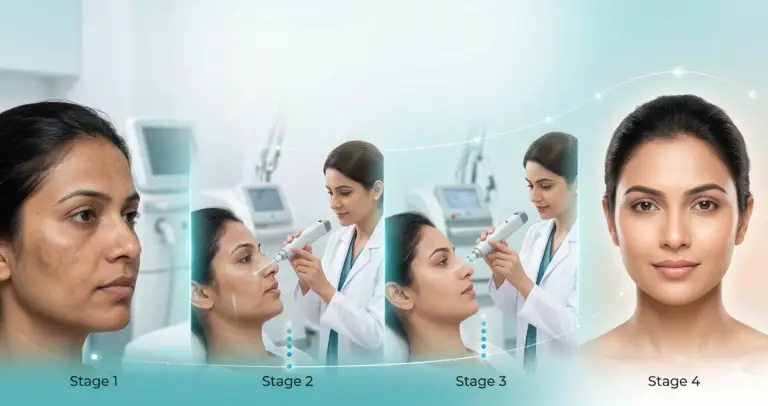
Managing expectations across the treatment course is as important as the treatment itself. Here is a realistic progression for a typical patient undergoing laser toning for moderate pigmentation:
- After Session 1: Skin appears slightly brighter with improved radiance. Discrete dark spots may show minimal change. The improvement is subtle but perceptible.
- After Sessions 2–3: Visible lightening of superficial pigmentation begins. Sun spots and recent PIH show the most change at this stage. Overall skin tone starts appearing more even.
- After Sessions 4–5: Significant improvement in most epidermal pigmentation types. Skin texture refines noticeably due to collagen stimulation. Melasma patients begin to see meaningful clearing, though patches remain partially visible.
- After Sessions 6–8: Deep or persistent pigmentation continues to clear. Melasma patients typically see their best results in this range. Skin tone is notably more uniform and luminous.
- Beyond Session 8: Maintenance phase. Sessions are spaced further apart — typically every 4 to 8 weeks — to sustain results and prevent recurrence, particularly for melasma.
Is Laser Toning Enough on Its Own, or Does It Need Combination Therapy?
For mild, epidermal pigmentation, laser toning alone is often sufficient. However, for more complex conditions — particularly melasma, deep PIH, or mixed pigmentation — dermatologists frequently recommend combining laser toning with one or more of the following:
- Topical depigmenting agents — such as tranexamic acid, niacinamide, azelaic acid, or physician-prescribed hydroquinone — used between sessions to suppress melanin production
- Chemical peels — particularly glycolic acid or lactic acid peels — which complement laser toning by improving cell turnover and reducing epidermal melanin
- Oral tranexamic acid — particularly effective for melasma with a hormonal component, as it reduces melanin synthesis from within
- Sunscreen and antioxidant serums — a non-negotiable daily protocol for anyone undergoing any pigmentation treatment
At Vesta Skin Clinic, Dr. Uma evaluates each patient’s pigmentation individually and designs a pigmentation treatment plan that may combine laser toning with complementary approaches for superior and longer-lasting results.
Laser Toning vs Other Pigmentation Treatments: A Comparison
If you are evaluating your options for pigmentation treatment in Chennai, this comparison gives you a clear picture of where laser toning sits relative to other available approaches:
For most patients with moderate-to-significant pigmentation, a combination of laser toning with one additional modality delivers better results than either treatment in isolation.
Why Pigmentation Comes Back — and How to Prevent It
One of the most frustrating aspects of pigmentation treatment — particularly for melasma — is that it can return even after a successful course of laser sessions. Understanding why this happens is the first step to preventing it.
Melanocytes have memory. Once melanocytes in a particular skin area have been overactivated — by UV exposure, hormones, or inflammation — they remain primed to overproduce melanin again when exposed to the same triggers. Laser toning clears the existing pigment but does not permanently deactivate the melanocytes responsible for it.
Prevention requires an ongoing commitment to:
- Daily SPF application — broad-spectrum SPF 50 is ideal, applied every morning and reapplied every 2 to 3 hours during outdoor exposure
- Antioxidant serums — Vitamin C in particular helps neutralise free radicals generated by UV exposure and reduces melanin oxidation
- Maintenance laser sessions — typically one session every 4 to 8 weeks once the initial treatment course is complete
- Avoiding known triggers — for hormonal melasma, this may involve reviewing oral contraceptive choices with your physician
- Indoor sun protection — UV rays penetrate windows, and in Chennai’s climate, ambient UV levels are high enough to stimulate melanin even indoors
Vesta Skin’s pigmentation treatment protocol includes a detailed maintenance plan that patients follow after completing their initial course of laser toning — addressing the recurrence issue proactively rather than reactively.
What to Look for When Choosing a Laser Toning Clinic in Chennai
Laser toning is a medical procedure. How it is performed — the laser system used, the settings applied, and the skill of the clinician — directly determines both the safety and effectiveness of the outcome. When evaluating clinics in Chennai, consider the following:
Dermatologist involvement: Laser toning should be assessed and supervised by a qualified dermatologist who can determine appropriate settings for your skin tone and pigmentation type. Incorrect settings on darker skin can worsen pigmentation rather than improve it.
Equipment quality: Ask about the specific laser system being used. Medical-grade Q-switched Nd:YAG lasers — such as the Iris Bluetoning system used at Vesta Skin — deliver more precise and consistent energy compared to older or poorly maintained devices.
Holistic treatment planning: The best outcomes come from clinics that treat pigmentation as a systemic concern — addressing lifestyle factors, hormonal influences, and skincare alongside the laser sessions — not just the laser itself.
Honest session estimates: Be cautious of clinics that promise dramatic results in one or two sessions for significant pigmentation conditions like melasma. Realistic, transparent communication about treatment timelines is a mark of clinical integrity.
For those in Chennai looking for laser toning under expert dermatological supervision, Vesta Skin by Dr. Uma offers personalised pigmentation assessments and treatment plans. Dr. Uma’s approach combines the Iris Bluetoning laser system with a broader skin health strategy to address pigmentation at its root. Book a free consultation to receive an honest assessment of your specific pigmentation condition and what a realistic treatment plan looks like for your skin.
Frequently Asked Questions
1. Does laser toning hurt?
Laser toning is generally well-tolerated. Most patients describe a mild warmth or gentle snapping sensation during treatment. Numbing cream is not typically required, and the procedure is completed without significant discomfort.
2. Is laser toning safe for dark Indian skin?
Yes, when performed correctly with appropriate settings. The Q-switched Nd:YAG laser is one of the most established and studied laser systems for darker Fitzpatrick skin types. The key is working with a clinician experienced in treating South Asian skin tones.
3. Can laser toning make pigmentation worse?
Poorly calibrated laser settings, inadequate cooling, or treating skin that is actively inflamed or sun-damaged can trigger post-inflammatory hyperpigmentation — effectively worsening the condition being treated. This is why choosing an experienced dermatologist and following aftercare instructions rigorously is critical.
4. How soon do results show?
Initial brightening is often visible after the first 1 to 2 sessions. Significant pigmentation reduction typically becomes apparent between sessions 3 and 5, with the best results visible after completing the full recommended course.
5. Can I wear makeup after laser toning?
Most patients can resume light makeup use the day after treatment. On the day of treatment, avoid all makeup and skincare actives and apply only the soothing products and SPF recommended by your clinician.
6. How much does laser toning cost in Chennai?
Pricing varies across clinics based on the laser system used, the number of sessions, and the treatment area. Contact Vesta Skin for a personalised quote based on your specific pigmentation assessment.
Final Thoughts
The honest answer to “how many laser toning sessions do you need for pigmentation” is: it depends — and anyone who tells you otherwise without examining your skin is guessing.
What the evidence consistently shows is that laser toning is effective for most types of pigmentation when combined with strict sun protection, appropriate session spacing, and realistic expectations. For sun spots and mild PIH, results can be impressive within 4 to 5 sessions. For melasma, it is a longer commitment — but one that delivers meaningful improvement when approached correctly.
The most important step is getting an accurate diagnosis of your pigmentation type before starting any treatment. A proper assessment tells you not just how many sessions you need, but which treatment — or combination of treatments — is most appropriate for your specific concern.
If you are based in Chennai and would like a comprehensive pigmentation assessment, Vesta Skin by Dr. Uma at T Nagar offers free consultations where Dr. Uma evaluates your pigmentation type, depth, and skin tone before recommending a personalised treatment plan.
📞 +91 7709393369 / 9342548815
📍 Third Floor, Villa, 12/26, Coats Road, T Nagar, Chennai — 600017