Dermal Fillers vs Botox: Which One Is Right for Your Face?
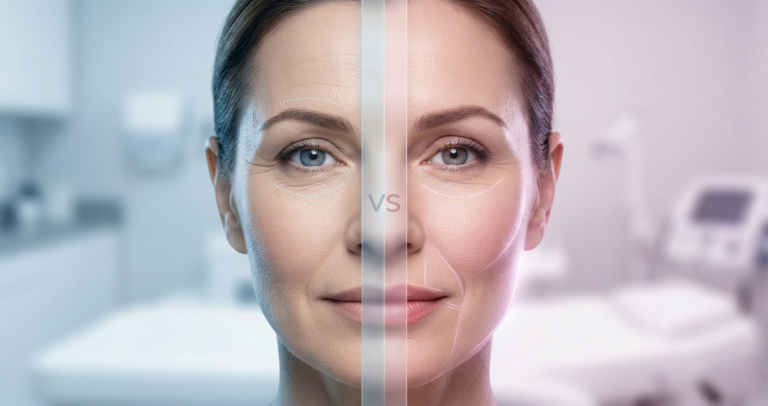
Botox relaxes the muscles that cause dynamic wrinkles — lines formed by facial expressions like frowning or squinting. Dermal fillers restore lost volume, lift sagging areas, and smooth static wrinkles — lines present even when your face is at rest. They work through completely different mechanisms, treat different concerns, and are often most effective when used together. Neither is universally better — the right choice depends entirely on what your face actually needs.
“Should I get fillers or Botox?” is one of the most searched questions in aesthetic medicine in India right now — and also one of the most frequently misunderstood. The two treatments are often spoken about interchangeably, bundled together in the same category of “injectables,” and assumed to work the same way. They do not.
Choosing the wrong treatment for your specific concern will not only fail to deliver the results you are hoping for — it can sometimes make the area look worse. Understanding the fundamental difference between dermal fillers and Botox before walking into any clinic is not just useful, it is essential.
This guide explains exactly how each treatment works, which facial concerns each one addresses, how long results last, what risks to be aware of, and — most importantly — how to determine which one your face is actually asking for.
The Fundamental Difference: Muscle vs Volume
The most important thing to understand about dermal fillers and Botox is that they solve two completely different biological problems.
Botox — technically botulinum toxin type A — works by temporarily blocking the nerve signals that cause specific facial muscles to contract. When a muscle cannot contract, it cannot pull the overlying skin into a fold. The wrinkle that forms from that movement — a forehead line, a frown line, a crow’s foot — gradually softens and disappears as the muscle relaxes. Botox does not add anything to the skin. It removes a cause of wrinkling by pausing the movement that creates it.
Dermal fillers work through an entirely different mechanism. They physically add volume beneath the skin surface — replacing tissue that has been lost through the natural ageing process, or structurally reshaping areas of the face. Most modern dermal fillers are based on hyaluronic acid (HA), a substance that occurs naturally in the skin and holds water. When injected, HA fillers attract moisture and provide both immediate volume and gradual structural support over time.
In simple terms: Botox treats movement. Fillers treat volume loss.
What Causes Facial Ageing — and Why It Matters for Treatment Choice
To understand which treatment is right for you, it helps to understand the two main mechanisms driving facial ageing.
Dynamic Wrinkles: The Movement Problem
Every time you smile, frown, squint, or raise your eyebrows, a group of facial muscles contracts. Over thousands of repetitions across years and decades, the skin directly above those muscles loses its elasticity and begins to crease permanently at the points of maximum fold. These are called dynamic wrinkles — they form because of movement.
Dynamic wrinkles include:
- Forehead lines — horizontal lines from raising the eyebrows
- Frown lines (glabellar lines / “11” lines) — vertical lines between the eyebrows from frowning
- Crow’s feet — fine lines radiating from the outer corners of the eyes
- Bunny lines — lines on the sides of the nose from scrunching
- Lip lines — fine vertical lines above the upper lip from repeated puckering
These are the wrinkles that Botox treats best. Since the problem is muscular movement, relaxing the muscle is the logical and effective solution.
Volume Loss: The Structural Problem
Simultaneously, the face loses structural support through a process that begins in the mid-twenties and accelerates with each decade. Subcutaneous fat compartments shrink and descend. The facial bones gradually recede. Collagen and elastin production slows. The skin loses the scaffolding that held it lifted and full.
The results are visible as:
- Hollow cheeks and flattening of the mid-face
- Under-eye hollows and tear troughs — the dark shadow between the lower eyelid and cheek
- Nasolabial folds (smile lines) — grooves running from the nose to the corners of the mouth
- Marionette lines — lines running from the corners of the mouth downward
- Thinning lips and loss of lip definition
- Jowling and jawline softening — loss of a defined lower face contour
- Temple hollowing — the sunken appearance at the sides of the forehead
These are the concerns that dermal fillers address best. Since the problem is volume loss and structural deflation, restoring that volume is the appropriate solution.
Botox: What It Treats, How It Works, and What to Expect
Primary Treatment Areas
Botox is most effective and has the strongest evidence base for:
- Forehead lines (frontalis muscle)
- Frown lines / glabellar complex (procerus and corrugator muscles)
- Crow’s feet (orbicularis oculi muscle)
- Brow lift — a small amount of Botox placed above the lateral brow can gently elevate the outer brow arch
- Jawline slimming — Botox injected into the masseter muscle reduces the appearance of a wide jaw caused by muscle hypertrophy
- Neck bands — platysmal bands (vertical lines on the neck) respond well to Botox
- Gummy smile correction — Botox relaxes the upper lip elevator muscles, reducing the amount of gum visible when smiling
- Excessive sweating (hyperhidrosis) — Botox blocks the nerve signals to sweat glands
At Vesta Skin, smile correction and anti-wrinkle treatment using botulinum toxin are offered under direct supervision of Dr. Uma, with treatment plans tailored to individual facial anatomy.
How Long Does Botox Last?
Botox results are temporary. The nerve-blocking effect gradually wears off as the body metabolises the protein, typically within:
- 3 to 4 months for most first-time patients
- 4 to 6 months for patients who have had regular treatments over time — repeated relaxation of a muscle can lead to longer-lasting effects as the muscle gradually becomes less dominant
Patients who are very physically active, have high metabolic rates, or expose the treated area to significant heat shortly after treatment may notice results fading more quickly.
What Botox Will Not Do
Botox will not restore volume, lift significantly sagging skin, or improve static wrinkles — lines that are visible even when your face is completely relaxed and not moving. If your wrinkles are present at rest, they are not dynamic wrinkles, and Botox alone will not resolve them.
Dermal Fillers: What They Treat, How They Work, and What to Expect
Primary Treatment Areas
Hyaluronic acid dermal fillers are most effective for:
- Cheek augmentation and mid-face lift — restoring the high, rounded cheek contour lost through volume depletion
- Under-eye hollows / tear troughs — one of the most impactful filler treatments, reducing the hollowed or shadowed appearance under the eyes
- Nasolabial folds (smile lines) — softening the groove between the nose and mouth corners
- Marionette lines — reducing the downward pull at the corners of the mouth
- Lip augmentation and definition — adding volume, defining the cupid’s bow, and restoring lip border definition
- Jawline contouring — sharpening a soft or undefined jawline
- Chin projection — improving facial balance and proportion by adding forward projection to a recessed chin
- Temple filling — restoring fullness to hollow temples for a more youthful facial shape
- Hand rejuvenation — restoring volume to the back of the hands
Dermal fillers and lip enhancement treatment at Vesta Skin are performed using premium hyaluronic acid formulations, with treatment designed around the individual’s natural facial structure rather than a standardised template.
How Long Do Dermal Fillers Last?
Filler longevity varies depending on the product used, the injection depth, the treatment area, and individual metabolism:
Areas of high movement — like the lips — metabolise filler more quickly than areas of relative stillness, like the temples or jawline.
A Key Advantage: Reversibility
One of the most important and frequently overlooked advantages of hyaluronic acid fillers is that they are reversible. An enzyme called hyaluronidase can dissolve HA filler rapidly if a result is unsatisfactory or a complication occurs. This provides a meaningful safety net that is not available with permanent or semi-permanent filler options — which is one reason why HA-based fillers have become the global standard in aesthetic medicine.
Side-by-Side Comparison: Fillers vs Botox
Can Botox and Fillers Be Used Together?
Yes — and in many cases, they should be. The two treatments address different aspects of facial ageing and are not mutually exclusive. In fact, the combination approach — sometimes called a liquid facelift — is one of the most effective non-surgical strategies for comprehensive facial rejuvenation.
A common combined approach might look like:
- Botox to soften forehead lines, frown lines, and crow’s feet
- Fillers to restore volume in the cheeks, soften nasolabial folds, and define the jawline
- The result is a face that looks rested, refreshed, and naturally proportioned — rather than the “treated” appearance that comes from overdoing either product in isolation
The key to a natural-looking combined result is a conservative, anatomy-informed approach — which is why the experience and skill of the injecting clinician matters as much as the products themselves.
Which One Does Your Face Actually Need?
Use this as a general guide — but remember, only a qualified dermatologist examining your face in person can give you a definitive answer:
You likely need Botox if:
- Your wrinkles appear mainly during facial expressions and soften when your face is at rest
- You want to address forehead lines, frown lines, or crow’s feet
- You are in your late twenties to early forties with early-to-moderate dynamic wrinkling
- You want jawline slimming due to masseter hypertrophy
- You are bothered by a gummy smile
You likely need dermal fillers if:
- Your wrinkles or hollows are visible even when your face is completely relaxed
- You have lost cheek volume or facial fullness
- You have under-eye hollows, tear troughs, or a tired appearance unrelated to movement
- You want more defined lips, a sharper jawline, or improved chin projection
- You are in your mid-thirties or older with noticeable volume loss
You likely need both if:
- You have a combination of dynamic wrinkles and volume loss — which is the case for most patients over 35
- You want comprehensive rejuvenation rather than addressing a single concern in isolation
Important Safety Considerations
Both treatments should only be administered by qualified medical professionals — dermatologists, plastic surgeons, or trained cosmetic physicians — in a clinical setting. In India, the growing number of non-medical practitioners offering injectables in non-clinical environments is a significant safety concern.
Specific risks to be aware of:
- Botox risks: Temporary bruising at the injection site, headache, eyelid drooping (ptosis) if incorrectly placed near the brow, and asymmetry. All of these resolve as the product metabolises.
- Filler risks: Bruising, swelling, asymmetry, nodule formation, and — in rare but serious cases — vascular occlusion if filler is inadvertently injected into a blood vessel. This risk is substantially reduced when treatment is performed by an experienced clinician using proper technique, aspiration, and cannulas where appropriate.
Always ask your clinician about their qualifications, the products they are using, whether the product is licensed, and what their protocol is in the event of a complication.
At Vesta Skin by Dr. Uma, both anti-wrinkle treatment and dermal filler procedures are performed exclusively by Dr. Uma Maheswari — a qualified dermatologist trained internationally — using premium, licensed injectable products in a fully clinical environment.
What Does an Honest Consultation Look Like?
Before committing to either treatment, a good consultation should include:
- A detailed review of your specific concerns and what you hope to achieve
- An honest assessment of whether the treatment you are asking for is actually the right one for your concern
- A discussion of realistic expectations — including what the treatment cannot do
- Full transparency on the products being used, their longevity, and associated costs
- A clear explanation of potential risks and how the clinic handles complications
Be cautious of any clinic that agrees immediately to whatever you request without evaluating your face, or that discourages questions. The best aesthetic outcomes come from a collaborative conversation between patient and clinician — not a transactional appointment.
For those in Chennai looking for a thorough pre-treatment assessment for fillers or anti-wrinkle treatment, Vesta Skin offers a free initial consultation where Dr. Uma evaluates your facial anatomy and recommends the most appropriate treatment approach. Book your consultation here.
You can also explore anti-aging treatments and the full range of skin treatments at Vesta Skin for a broader understanding of what is available.
Frequently Asked Questions
1. Does Botox make your face look frozen?
Only when overdone or incorrectly placed. A skilled clinician uses conservative doses that soften wrinkles while preserving natural facial movement and expression. The “frozen” look is the result of poor technique or excessive product — not an inherent property of Botox.
2. Do dermal fillers look natural?
When placed by an experienced injector who respects natural facial proportions, HA fillers look entirely natural — enhancing your features rather than changing them. Overfilled results are a sign of excessive product use, not the nature of the treatment.
3. At what age should you start Botox or fillers?
There is no universal answer. Botox is sometimes used preventively in the mid-to-late twenties for patients with strong muscular activity. Fillers are more commonly used from the mid-thirties when volume loss becomes clinically visible. The right time is when a qualified clinician agrees that the treatment is appropriate for your concern.
4. Can fillers be dissolved if I do not like the result?
Yes — hyaluronic acid fillers can be dissolved rapidly using hyaluronidase injections. Results from dissolving are visible within 24 to 48 hours.
5. How much do dermal fillers and Botox cost in Chennai?
Pricing varies depending on the product used, the number of areas treated, and the clinic. Contact Vesta Skin for a transparent, personalised quote following your consultation.
6. Is there downtime after either treatment?
Both treatments have minimal downtime. Some bruising or swelling at the injection site is possible with fillers — particularly in high-vascularity areas like the lips — and typically resolves within 3 to 5 days. Botox has virtually no downtime.
Final Thoughts
Dermal fillers and Botox are both effective, well-studied treatments — but they are not interchangeable, and treating them as the same thing leads to mismatched results.
The simplest way to think about the decision: if your concern is movement-driven and your skin springs back when your face is relaxed, Botox is likely the more appropriate starting point. If your concern is about hollowness, lost volume, or lines that are visible at rest, fillers are the better fit. And if you have both — which most people over 35 do — a combination approach is usually the most effective path.
Whatever you decide, the quality of the outcome depends far more on the clinician performing the treatment than on the product itself. Choose a qualified dermatologist, ask questions, and expect honesty about what each treatment can and cannot do for your specific face.
For those in Chennai seeking a thorough, honest assessment of which injectable treatment is right for them, Vesta Skin by Dr. Uma at T Nagar offers free consultations, transparent treatment planning, and procedures performed exclusively under dermatologist supervision.
📞 +91 7709393369 / 9342548815
📍 Third Floor, Villa, 12/26, Coats Road, T Nagar, Chennai — 600017